
Canine Wise understands that successful puppy training in Sydney often begins with helping a puppy settle before introducing more demanding behaviours. An overexcited puppy is more likely to jump, nip, grab the lead or lose focus, making training sessions frustrating for both the puppy and its owner. Building calmness first creates a stronger foundation for learning.
Helping a puppy move from excitement to focus requires an understanding of what drives the behaviour. Sleep, routine, the surrounding environment, physical needs and the puppy’s stage of development can all affect its ability to concentrate. By managing these factors and choosing the right time to train, owners can encourage better focus and more consistent progress.

Why Excited Puppies Struggle to Learn
An overexcited puppy is not necessarily being stubborn or defiant. When arousal becomes too high, the puppy’s ability to notice cues, control impulses and retain new information can decline significantly.
Movement, toys, people, other animals and unfamiliar environments can push a young puppy beyond the point where it can respond reliably. Helping the puppy settle before asking for complex behaviours can make training clearer and more productive.
High Arousal Makes Concentration Difficult
Learning generally happens best when a puppy is alert and engaged without being overwhelmed. As excitement or stress rises, it becomes harder for the puppy to process cues, solve simple problems and control immediate impulses.
This helps explain why a puppy that responds to “sit” in a quiet kitchen may struggle to perform the same behaviour at a busy park. The cue is competing with unfamiliar smells, moving people, other dogs and surrounding noise.
Repeatedly giving commands when the puppy is too distracted can create frustration. Instead, owners should increase distance from the distraction, simplify the exercise or pause until the puppy is able to re-engage.
Impulse Control Is Still Developing
Puppies are neurologically immature, and the skills involved in decision-making and self-control continue to develop as they grow. This makes instinctive reactions, such as jumping, chasing, mouthing and grabbing, easier than calm behaviours that require patience.
Exciting actions can also be immediately rewarding. Jumping may gain attention, pulling may move the puppy closer to something interesting and grabbing the lead can start a game.
Reducing excitement allows owners to reinforce alternatives such as:
- Keeping four paws on the floor
- Looking towards the handler
- Sitting before receiving attention
- Walking without pulling
- Resting on a mat
- Waiting briefly for food or toys
These small choices gradually help the puppy develop stronger impulse control.
Stimulating Environments Can Overwhelm Puppies
Busy parks, noisy homes and unfamiliar places may be too challenging before a puppy has learned to regulate excitement. Even familiar cues can become difficult when the puppy is processing several sights, sounds and smells at once.
Training should begin in a quiet, familiar area before distractions are introduced gradually. A puppy that succeeds inside the home may then progress to the garden, a quiet street and eventually more active environments.
The Australian Veterinary Association recommends positive and carefully managed puppy socialisation that considers body language, stress and the puppy’s response to new experiences.
Signs a Puppy Is Too Overstimulated to Train
Recognising when a puppy is too wound up to learn is important. Training during intense overstimulation often creates frustration rather than useful progress.
Owners should watch for changes in body language and behaviour that show the puppy has moved from playful engagement into a frantic, scattered or emotionally overwhelmed state.
Constant Movement and Inability to Focus
A puppy that is ready to train may move quickly but should still be able to pause, take food and briefly check in with the handler.
Signs that excitement may be too high include:
- Constant zooming or pacing
- Repeatedly jumping on furniture or people
- Ignoring its name or familiar cues
- Being unable to remain still for even a brief moment
- Refusing food that it would normally enjoy
- Moving with a tense rather than loose body
- Fixating on surrounding movement, sounds or animals
When the puppy cannot disengage from the environment, the session should be simplified or postponed.
Intense Mouthing, Barking or Vocalising
Mouthing is a normal part of puppy development, but overstimulation can turn gentle exploration into repeated or increasingly forceful grabbing.
The puppy may nip hands, clothing or the lead and become more intense when someone tries to disengage. The behaviour may appear frantic and increasingly difficult to interrupt.
Excessive barking, whining, squealing or screaming can also indicate that the puppy is over its coping threshold. Asking repeatedly for sits or downs at this point may add frustration rather than reduce excitement.
Scattered Behaviour or Emotional Overload
Some overstimulated puppies rapidly switch from one behaviour to another. A puppy may sniff, jump, mouth, bark and grab objects without settling into any activity.
Other puppies respond by withdrawing or shutting down. Signs may include:
- Refusing to move
- Flattening against the ground
- Scratching or sniffing repetitively
- Rolling onto the back
- Panting in mild conditions
- Showing wide or glassy eyes
- Avoiding interaction
These behaviours should not automatically be treated as stubbornness. Training should pause while the puppy is moved to a quieter environment and given time to recover.
The Role of Sleep, Routine and Quiet Time
A puppy that appears excessively energetic may be overtired or lacking a predictable routine. Sleep and planned quiet time support concentration, emotional regulation and recovery from daily stimulation.

Before increasing the intensity or duration of training, owners should consider whether the puppy is receiving enough rest and whether its daily schedule is suitable for its age.
How Much Sleep Does a Puppy Need?
Many young puppies may sleep for approximately 18 to 20 hours across a 24-hour period, although individual needs vary according to age, breed, health and activity level.
The RSPCA NSW explains that puppies need plenty of sleep and quiet time to rest, recover and regulate their behaviour.
Signs that a puppy may be overtired include:
- Zoomies that become difficult to interrupt
- Harder or more frequent biting later in the day
- Ignoring cues it usually follows
- Becoming increasingly vocal
- Struggling to settle independently
- Falling asleep quickly once placed in a quiet environment
A consistent bedtime, regular daytime naps and reduced activity before sleep can help the puppy switch off more easily.
Sudden changes in sleeping patterns, unusual restlessness or an inability to become comfortable should be discussed with a veterinarian.
Creating a Predictable Daily Routine
Predictable patterns can help puppies feel secure and understand when it is time to eat, play, train or rest.
Following a consistent approach to building good habits in a puppy from day one can make rest, training and household expectations easier to understand.
A balanced routine may include:
- An opportunity to toilet
- A short training or enrichment activity
- Gentle play or supervised exploration
- A period of calm rest
Very young puppies generally benefit from short activity periods followed by longer opportunities to sleep. Long stretches of stimulation can contribute to mouthing, barking and loss of focus.
Meals can also support the routine. Part of the puppy’s normal food allowance may be used for brief training sessions so calm engagement is rewarded without adding unnecessary calories.
Providing Purposeful Quiet Time
Puppies do not always choose to rest while interesting activity is available. Owners may need to create a calm space where the puppy can relax without constant interaction.
A crate, pen or gated room may be useful, but confinement should be introduced gradually and positively. The area should not be used as punishment.
Owners can provide:
- Comfortable bedding
- An appropriate chew
- A food-stuffed toy
- Low lighting and minimal noise
- Distance from household foot traffic
Family members and visitors should avoid disturbing the puppy while it is resting.
If confinement causes persistent panic, escape attempts, heavy panting or extreme vocalisation, the puppy should not simply be left to become increasingly distressed. A qualified trainer, veterinary professional or behaviour specialist should be consulted.
Using Calm Decompression Activities
Decompression does not always require complete inactivity. Low-key activities can help a puppy recover after excitement.
Suitable options may include:
- Gentle scatter feeding
- Sniffing in a secure garden
- A brief, age-appropriate sniffing outing
- Licking or chewing an appropriate item
- Sitting quietly with a familiar person
- Exploring a calm environment at its own pace
These activities should be kept relaxed and should not become another source of intense stimulation.
Creating the Right Environment for Calm Training
The training environment can determine whether an excited puppy succeeds or becomes more distracted. Before asking for sits, downs or recalls, owners should create a space that supports concentration.
The goal is not to remove every distraction permanently. It is to control the difficulty so the puppy can practise calm behaviour successfully.
Choose a Low-Distraction Location
Early training should begin in a quiet part of the home. A busy hallway, kitchen or room beside the front door may expose the puppy to too much movement.
A suitable space may include:
- A bedroom or quiet living area
- Limited foot traffic
- A television that is turned off
- Closed or partly closed curtains
- A non-slip rug or carpeted floor
- Distance from windows facing busy streets
Outdoor training should begin in a secure, quiet area before the puppy is expected to concentrate around traffic, children or other dogs.
The puppy’s vaccination status and the veterinarian’s advice should also be considered before visiting public areas.
Use Equipment That Supports Settling
The layout of the training space should make calm choices easier.
A bed or mat can become a visual target for resting. It should be positioned away from doors and busy walkways. Repeatedly rewarding the puppy for approaching, standing on or lying on the mat can build a positive association.
Highly stimulating toys, such as squeaky toys or fast-moving balls, may be removed during calm training. More suitable items may include:
- Small, soft training treats
- Part of the puppy’s normal meal
- A low-key chew
- A food toy that encourages licking
- A comfortable mat or bed
A lightweight lead attached to a suitable harness may help manage wandering, but it should only be used under direct supervision. The puppy should have enough room to sit, stand and lie down comfortably without becoming tangled.
Manage Human Movement and Tone
Puppies respond strongly to human body language. Loud instructions, fast hand movements, clapping and repeated collar grabbing can increase excitement.
Calm training is more effective when the handler:
- Uses a quiet voice
- Moves slowly
- Gives each cue once
- Keeps the body relaxed
- Delivers rewards smoothly
- Allows the puppy time to respond
Training should also be scheduled when the household is relatively calm. Beginning a session while visitors are arriving, meals are being prepared or children are running through the room may make success unnecessarily difficult.
Simple Ways to Help a Puppy Relax Before Training
A brief and predictable settling routine can help a puppy move from play or exploration into a state that is more suitable for learning.
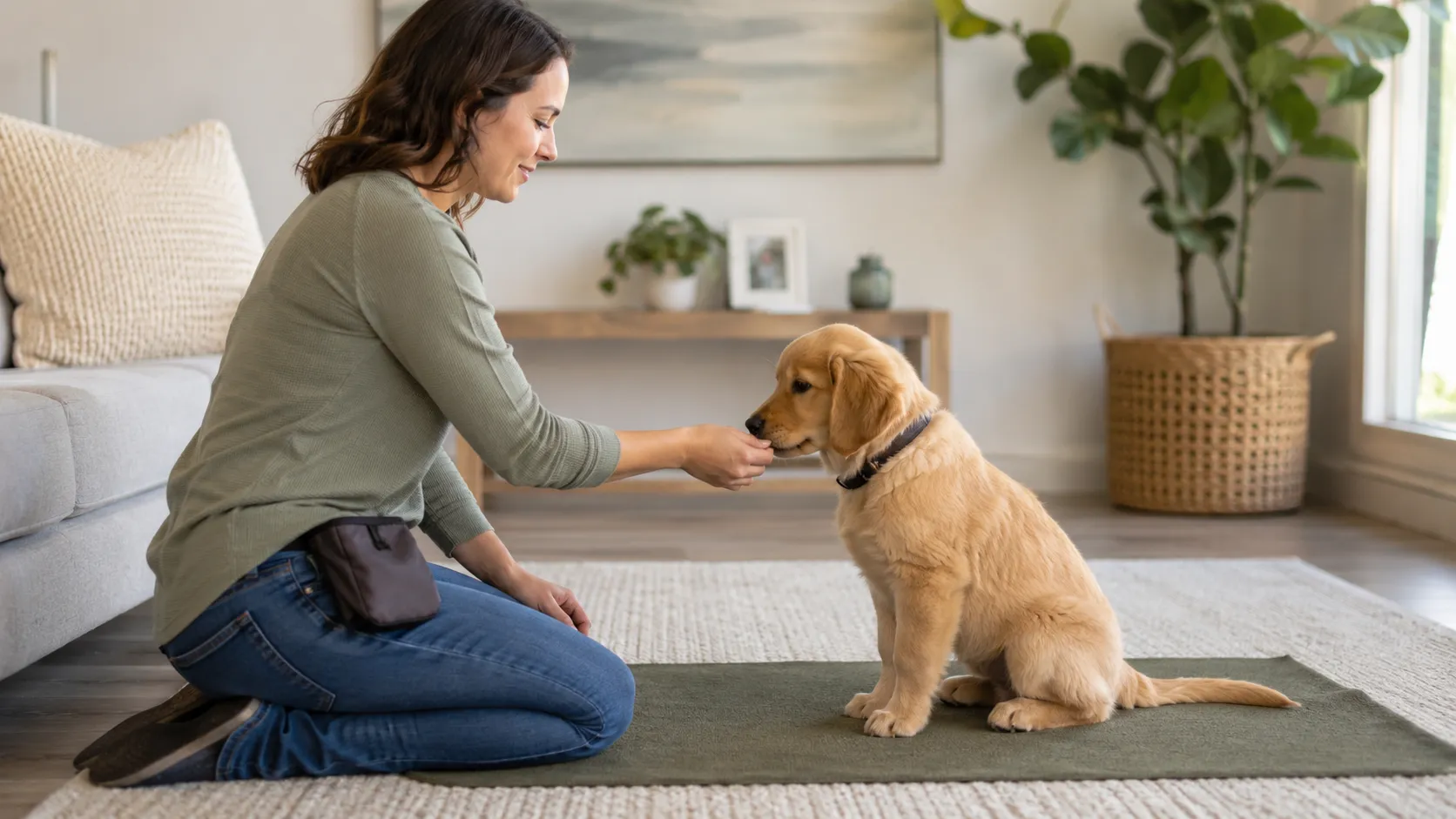
The aim is not to exhaust the puppy. It is to reduce excitement enough for the puppy to notice the handler and respond to simple cues.
Use a Short Pre-Training Routine
A practical routine may include:
- Give the puppy an opportunity to toilet.
- Allow one or two minutes of gentle sniffing or chewing.
- Move to a quiet training area.
- Wait for the puppy to pause or look towards the handler.
- Reward an easy, familiar behaviour.
The first behaviour may be as simple as standing with four paws on the floor, responding to its name or touching a hand target.
Rewards should be delivered calmly. Fast movements, excited praise or tossing food across the room may increase arousal again.
Reinforce Calm Behaviour When It Happens Naturally
Owners do not always need to ask for a formal cue. Calmness can be rewarded whenever the puppy offers it voluntarily.
Useful moments to reinforce include:
- Lying down without being prompted
- Looking at a distraction and then looking away
- Pausing instead of jumping
- Sitting before receiving food
- Relaxing beside a person
- Choosing to rest on a mat
Quietly placing a treat between the puppy’s paws can reward settling without causing it to leap back up.
Avoid Forcing Physical Relaxation
Some puppies enjoy slow stroking or gentle contact, while others become more excited when touched. Handling should not be used to restrain a struggling puppy or force it into a down position.
Owners should observe the puppy’s response. If physical contact causes mouthing, wriggling or avoidance, calmness may be encouraged more effectively through space, sniffing, chewing or mat training.
When to Begin Short Obedience Sessions
Simple training can begin when a puppy comes home, provided the sessions are brief, positive and suited to the puppy’s developmental stage.
The focus should be on communication and good habits rather than strict obedience. Useful early skills include:
- Name recognition
- Coming when called over a short distance
- Sitting
- Following a hand target
- Settling on a mat
- Allowing gentle handling
- Walking towards the handler on a loose lead
Keep Sessions Brief
Very young puppies may only manage one or two minutes of focused training before they need a break. Older puppies may gradually work for several minutes, but the appropriate length depends on the individual.
Several brief sessions throughout the day are usually more productive than one long session.
Training should end while the puppy is still engaged. Signs that a session has continued too long include:
- Wandering away
- Sniffing continuously
- Jumping repeatedly
- Mouthing the handler
- Grabbing the lead
- Refusing food
- Barking or becoming frustrated
Stopping before the puppy becomes overwhelmed helps maintain positive associations with training.
Choose the Right Moment
Timing is more important than following a rigid clock.
Useful training opportunities may occur:
- After an age-appropriate toilet outing
- Following gentle play or sniffing
- Before a meal
- After the puppy wakes from a nap
- During naturally quiet periods
- When the puppy voluntarily checks in
Training should not begin immediately after an intense game, during peak excitement or when the puppy is clearly overtired.
A puppy that is able to take food gently, respond to its name and briefly orient towards the handler is more likely to be ready.
Know When to Pause
If the puppy begins leaping, biting hard, barking continuously or ignoring food, owners should pause and consider what the puppy needs.
Possible needs may include:
- Toileting
- Sleep
- Water
- Distance from a distraction
- A calmer environment
- A safe chewing activity
- Relief from discomfort
Training is more effective when those needs are addressed instead of repeatedly insisting on a response.
When a Puppy May Need Additional Support
Many lively puppies improve with consistent routines, suitable rest and calm reinforcement. Some puppies, however, experience levels of excitement, distress or reactivity that significantly affect daily life.
Professional support should be considered when the behaviour is frequent, intense or difficult to manage safely.
Signs That Excitement Is Becoming a Serious Concern
Warning signs may include:
- Regular biting that breaks the skin
- Frantic barking or screaming when frustrated
- An inability to settle after normal needs have been met
- Repeatedly crashing into furniture or people
- Knocking over children
- Jumping that becomes more intense when attention is removed
- Extreme distress when briefly separated from household members
- Behaviour that is becoming progressively worse
A qualified reward-based trainer can assess the puppy’s environment, routine and learning history before recommending a tailored plan.
When Safety or Daily Life Is Affected
Additional guidance is particularly important when:
- Children are afraid to move around the home
- The puppy is isolated for long periods because interaction feels unmanageable
- Walks or outings are avoided because of barking or lunging
- The puppy repeatedly injures itself during frantic behaviour
- Visitors cannot enter safely
- Owners feel unable to control the puppy without physical force
Early support can help prevent difficult patterns from becoming more established.
When Veterinary Assessment Is Appropriate
Behaviour that appears to be excess energy may sometimes be influenced by pain, discomfort, illness or anxiety.
A veterinary assessment should be considered when:
- Behaviour changes suddenly
- The puppy appears unable to become comfortable
- Panting, drooling or restlessness occurs without an obvious reason
- Sleep patterns change significantly
- The puppy becomes unusually sensitive to touch
- Appetite, toileting or mobility changes
- Routine and training adjustments do not improve the problem
A veterinarian can rule out health concerns and, when necessary, refer the puppy to a veterinary behaviourist or another appropriate professional.
Building Calmness Before Expecting Obedience
Helping an overexcited puppy settle is an important part of early training. Consistent routines, sufficient sleep, suitable enrichment, structured quiet time and thoughtfully timed rewards can all improve focus and self-regulation.
The same principles used for teaching calm behaviour in high-energy dogs can help puppies develop stronger settling skills as they mature.
Owners should aim to work with the puppy’s developmental stage rather than expecting prolonged concentration or perfect impulse control. By gradually increasing distractions and reinforcing calm choices, puppies can develop the confidence and skills needed for training and everyday life.
Canine Wise helps owners understand their puppies’ behaviour and build practical training routines that support calmer, more attentive and manageable companions.

